
Rain coming through the ceiling, a ridge lifted in the night or slates on the drive after a gale? Flintshire is our home patch, so we know these roads, these estates and how the weather comes in off the Dee. We make the roof safe, stop or slow the water, then quote the permanent repair in writing. Emergency call-outs from Mostyn and Greenfield to Mold, Buckley, Connah’s Quay and Queensferry, including evenings and weekends, subject to weather, access and the nature of the damage.



Five quick questions we ask on the phone. If you answer yes to any of the first four, ring or WhatsApp now. The last one covers the jobs that can safely be booked in for a dry day.
A growing brown patch, a drip from a light fitting or water running down the inside of a gable wall all count as active leaks. Put a bucket under it, move anything valuable, and if water is near a light or socket switch that circuit off at the consumer unit if you can do so safely. Then call us with your postcode.
Look from the pavement or the back garden, never from a ladder. Bare battens, a missing ridge tile or a dark hole in the slope mean the roof is open, and the next band of rain will go straight in even if the bedroom ceiling still looks fine. That is a call-out.
A chimney pot leaning after a gale, a length of gutter swinging from one bracket, or broken slates on the path below are a hazard before they are a leak. Keep children, pets and visitors clear of that side of the house and ring us.
Back extensions, garages and dormers across Connah’s Quay, Shotton and Buckley often fail during a downpour when an outlet blocks or an old covering splits. If water is pooling and coming through, we treat it as urgent and aim to cut it off on the first visit.
A single slipped slate with no water coming in, an old dry stain, moss in the gutters or a cracked tile you only spotted from the street can usually be booked for a planned repair. Tell us what you can see and we will say honestly whether it is urgent. Homeowners can request a free quote for that planned work.
This is how a Flintshire emergency usually runs. Being local means fewer miles on the road, but we still only work on a roof when it is safe to be up there.
Give us the address, what has failed and whether water is getting in now. A couple of photos taken from the garden or from the room underneath tell us whether to load ladders, a roof ladder, sheeting or lead, and save time once we arrive.
Our yard is in Holywell, so most Flintshire towns are a short run along the A55, the A548 coast road, the A5026 or the A541 towards Mold. We will give you a realistic arrival window and keep you posted if conditions or another job change that.
First we deal with anything that could fall or let more water in. Then, if the wind and light allow, we carry out the make-safe: refixing slates, sheeting an opening, clearing a blocked outlet or sealing a lifted flashing. If it is genuinely too dangerous at night, we protect what we can from below and return at first light.
Once the house is dry we explain what failed, why it failed and what the proper repair involves. You receive a written quote before any permanent work starts, and the completed repair carries our 10-year workmanship guarantee.
Every roof is different, so these are the options rather than promises. All of them are temporary measures to protect the property until the lasting repair.
Where only a few slates or tiles have slipped, we can often refix or swap them on the spot, using matching spares where we carry them.
For a larger hole we fix heavy-duty sheeting with battens so it survives the next blow off the estuary, rather than a loose sheet that flaps free overnight.
Leaves and silt in a valley, hopper or flat roof outlet can push water under the covering. Clearing them often stops the leak there and then.
Where a flashing has peeled away from a stack or a wall, we dress it back or seal it temporarily so rain runs off rather than in.
A localised split on a garage or extension roof can often be patched with liquid rubber to buy time before a proper recover.
From the coast at Mostyn to the English border at Saltney Ferry, Flintshire packs a lot of different roofs into a small county. These are the areas we are called to most often, with a note on what tends to fail in each.
We are on the A55 within minutes of leaving the yard, with the A548 for the coast and Deeside, the A5026 and A541 for Mold, and the A494 for Buckley and Ewloe.
Planned roofing: roofers in Flintshire, with local pages for Holywell, Flint, Mold, Buckley and Connah’s Quay.
Other emergencies: the emergency roof repairs hub, plus our Chester, Wrexham and Wirral call-out pages.
Housing and exposure change quickly between the coast, the hills and Deeside. Open a heading to see the pattern we find most in that part of Flintshire.
Along the A548 the roofs face straight across the Dee towards the Wirral, and a north-westerly drives rain up under slates and into the tops of gable walls. Older stone and rendered houses in Ffynnongroyw, Mostyn and Bagillt often have mortar-bedded ridges and verges that loosen over time, so one gale can strip a run of ridge tiles at once.
Holywell climbs steeply from Greenfield up to the town centre and Pen-y-Maes, so many terraces step down the slope with a party wall, a shared chimney and a small valley between each roof. When one house leaks it is often through the junction with next door, which means looking at both sides before deciding who needs what.
Rhosesmor, Halkyn, Pentre Halkyn and Rhes-y-Cae sit high and open, with very little shelter from the wind. Cottages built from local stone tend to have heavy slate roofs, deep chimney stacks and lime mortar that needs the right repair. Lifted slates, cracked flaunching and water tracking down chimney breasts are the usual call-outs after a winter storm.
Connah’s Quay, Shotton and Queensferry have long rows of terraced and semi-detached homes, many with flat-roofed rear kitchens, bathrooms or garages added over the decades. These lower roofs collect leaves and silt from the main roof and are often where an emergency starts, particularly where an outlet runs into a single downpipe.
Buckley grew on brick and clay, and much of its housing is brick with concrete interlocking tiles. Around Mold, Ewloe, Northop Hall and Broughton there are also many estates built since the 1980s with dry-fix ridges and verges. These roofs are usually sound overall, so emergencies tend to be a single failed ridge, a cracked verge or a blocked valley rather than a whole slope.
None of these need a ladder. They limit the damage indoors and help us get straight on with the job when we arrive.
Wet slates and tiles are treacherous, especially in wind. However small the job looks, please leave it to us. A fall from a bungalow roof can be as serious as a fall from a house.
Buckets, washing-up bowls and old towels are your friends. If a ceiling is bulging with water, keep people out of that room; a small hole made deliberately in the lowest point with a screwdriver, standing to one side over a bucket, can stop the whole ceiling coming down. Only do this if you feel safe doing it.
If water is near a light fitting, a socket or the loft wiring, switch that circuit off at the consumer unit where you can reach it safely. If you are unsure, keep everyone away and tell us when you call.
Photos from the street, the garden and the room below help us judge what we are dealing with. They are also useful if you later decide to contact your home insurer. Send them on WhatsApp to 07405 569991.
If you can, move the car off the drive and unlock the side gate. Let us know if there is a dog, a conservatory under the leak or any tricky access, such as a steep garden in Holywell or a narrow back lane in Shotton.
Pick a heading to read more. Each tab covers what usually causes that problem here, and how we deal with it.
The worst storms usually arrive from the west and north-west, funnelling up the Dee estuary and over the coast road villages before they reach Flint and Deeside. Ridge tiles, verge tiles and the top courses of slates are the first to go, especially on older roofs where the mortar has weakened.
We gather what can be reused, secure the gap and return to rebed or mechanically fix the ridge so it stays put next time. Photos of the damage and of our work can be provided if you ask, for your own insurance claim.
Water rarely comes in exactly where it shows. A stain on a Mold landing ceiling might start at a cracked slate two metres higher up, a perished mortar fillet at a party wall or a chimney flashing on the far side of the stack.
We trace the leak back to where it starts, then deal with that point rather than just the patch you can see. If the cause is not obvious from the outside, we will look in the loft as well.
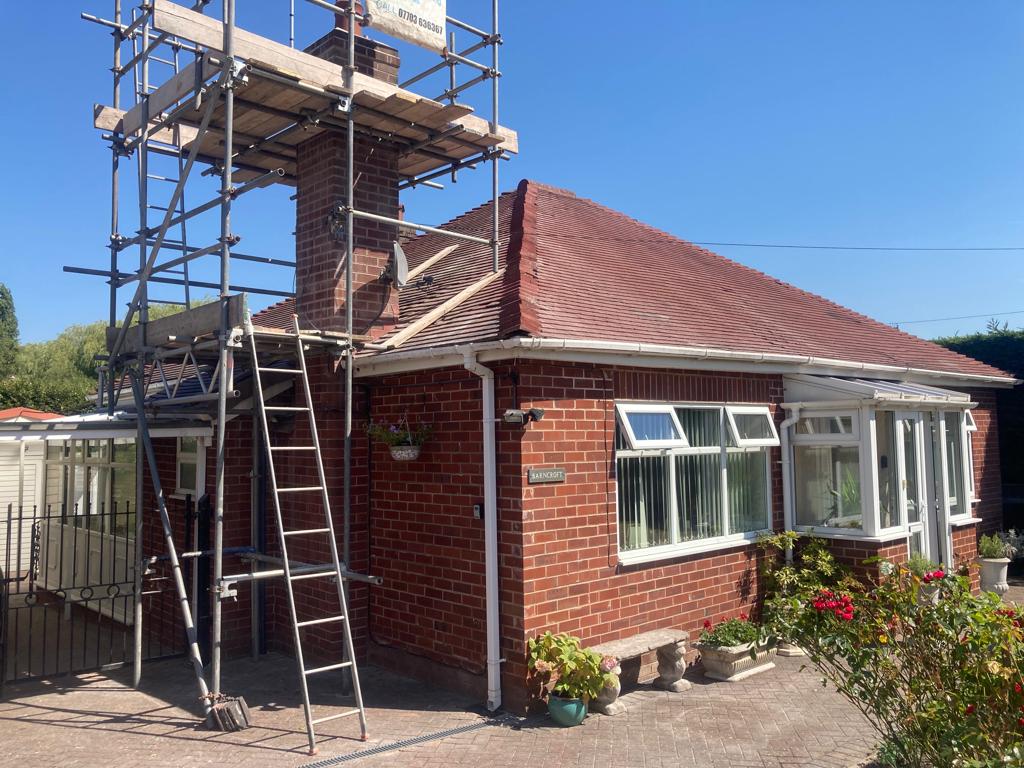
Flintshire has thousands of chimneys that are no longer used but still stand proud of the roof, getting the full force of the weather. Cracked flaunching, loose pots, eroded pointing and lifted lead let water run straight down into bedrooms and chimney breasts.
A loose pot is made safe first. Lasting chimney repairs, such as new lead flashing or rebuilt flaunching, are quoted separately. See our roof repairs page for planned chimney work.
Garages, kitchen extensions and dormers lose their weatherproofing quickly once a covering has split or the outlet blocks. Ponding water then finds every weak seam. This is one of the most common Deeside and Buckley call-outs in autumn.
We clear outlets, dry the area where we can and patch with liquid rubber. If the covering has failed across the whole roof, we will quote a recover with a modern system such as Owl Lava20 liquid rubber. More on our flat roofs page.
An overflowing gutter can soak a wall in an afternoon and push damp through to the plaster inside. Snapped brackets, sagging runs and blocked downpipes are common under the trees around Hawarden, Northop and Mold.
We clear the run and refix what is there on the first visit. If the system is past saving, we quote for new guttering, fascias and soffits. Read more on our uPVC roofline page.
Make-safe work buys time, not years. Once the immediate problem is under control we explain the options in plain English and put the price for the proper repair in writing so you can decide in your own time.
Matched replacements fixed with the right nails, clips or hooks, plus a check of the surrounding courses for other weak spots. More on our pitched roofs page.
Mortar-bedded ridges rebedded properly, or upgraded to a mechanically fixed dry ridge or dry verge where it suits the roof and the house.
New lead flashings, rebuilt flaunching and repointing so the stack stops letting water down the breast. See roof repairs.
A complete recover in liquid rubber or EPDM where the old covering has reached the end of its life. See flat roofs.
New gutters, downpipes, fascias and soffits so water is carried well clear of the walls. See uPVC roofline.
Every permanent repair we complete is covered by our 10-year workmanship guarantee, so you are not left paying twice if it lets go.
A quick reference for the faults we meet most in Flintshire, showing what we aim to do on the night and what the proper repair usually involves.
People often worry about the bill before anything else. Here is how it works with us, in plain terms.
It depends on the time, the access and how much make-safe work is needed. Before we set off we tell you how the attendance is charged and what the temporary work is likely to involve, so there are no surprises on the doorstep.
Yes. Once the roof is safe we explain what needs doing and send a written quote. Nothing permanent is started until you have agreed it. For homeowners, the quote for that planned repair is free.
Your claim is between you and your insurer. If you ask, we can provide dated photos and a written note of what we found and what we did, which most insurers find helpful. We cannot predict whether a claim will be accepted.
Permanent repairs carry our 10-year workmanship guarantee. A temporary make-safe is not a finished repair, so it is not covered in the same way, which is why we always quote for the lasting job.
Most emergencies are family homes, but plenty are rented houses and working buildings. Each needs a slightly different approach on the day.
Rented terraces in Holywell, Flint and Shotton often have tenants who only notice a problem when water is already through. Give us the tenant’s number and the access arrangements, and we will liaise directly so you are not stuck in the middle.
After the make-safe we send you photos and a written quote for the permanent repair, so the owner can approve it quickly. A free quote is available for planned work on the property once the emergency is over.
Workshops on Greenfield Business Park, units around Flint and Sealand, and the big sheds on Deeside Industrial Park all rely on box gutters, roof sheets and outlets that cope with heavy rain. When one fails, water lands on stock, machinery or the shop floor.
We attend to stop the ingress where it is safe to do so, protect the area below and agree the next step with whoever is responsible for the building. Planned work is covered on our commercial and industrial roofing page.
Most of the emergencies we attend started as something small that could be seen from the ground. Ten minutes in the garden after a storm, and again in autumn, makes a real difference.
If water is already coming in, skip the checklist. Go back to the emergency checker or call 07405 569991.
We are a local Holywell business, and our reputation travels by word of mouth from one street to the next. We have 250+ reviews across Google, Yell and MyBuilder; here are a few of them.
The questions Flintshire homeowners, landlords and businesses ask us most when a roof lets go.
Yes. Onyx Roofing is based in Holywell and was established by James, born and raised in Flintshire. Most of our work is in the county, from the coast villages to Deeside. You can read more about us on our about us page.
All of them, including Holywell, Greenfield, Bagillt, Flint, Connah’s Quay, Shotton, Queensferry, Mold, Buckley, Ewloe, Hawarden, Broughton, Mostyn, Talacre and the villages in between. If you are not sure, ring and ask.
Yes, emergency call-outs include evenings and weekends, subject to weather, access and the nature of the damage. If it is too dangerous to work at height in the dark or in a gale, we will protect what we can and return as soon as it is safe.
Being based in Holywell helps, but it still depends on the weather, traffic and any job we are already on. Expect an honest estimate on the phone, and a call if anything holds us up.
Please do not. Wet roofs and ladders in wind are the cause of many serious injuries every winter. Stay inside, contain the water and leave the roof to us.
Sometimes, for example a handful of slipped slates or a blocked outlet. Bigger repairs need materials, the right access or a dry day, so we make the roof safe first and then quote the permanent work.
We explain how the visit is charged and what the make-safe is likely to involve before we set off. The permanent repair is quoted separately in writing, and nothing goes ahead until you agree.
If you ask, we can provide dated photographs and a written description of the damage and of the work carried out. You remain in charge of the claim, and the insurer has the final say on it.
Yes. We make loose pots and failed flashings safe, then quote for lasting work such as new lead, rebuilt flaunching or repointing.
We clear the outlet, dry the area where possible and patch the leak with liquid rubber. If the covering has failed overall, we quote a full recover with liquid rubber or EPDM.
Yes. We can arrange access with tenants directly, make the roof safe and send photos and a written quote to the owner or agent for the permanent repair.
Yes. We attend units on Deeside Industrial Park, Greenfield Business Park and elsewhere in the county for box gutter, roof sheet and outlet leaks. Planned work is on our commercial and industrial roofing page.
Yes. Permanent repairs come with our 10-year workmanship guarantee. We also hold £5m public liability insurance with Covéa.
We will tell you. If the roof is weathertight and the problem can wait, we book it in as a planned repair, and homeowners can request a free quote. Slow leaks in Flint, Mold or Buckley usually fall into this group, and our roof leak repairs page explains how we deal with them.
Ring or WhatsApp 07405 569991 with your postcode and a photo if you can. We will tell you straight when we can get there, make the roof safe and quote the permanent repair in writing.


